



Application of Universal Joint in Steel Mills
2026-06-17 14:17In steel mills, universal joint serve as core components of the main drive system for rolling mills; they efficiently transmit power from the motor to the rolls while compensating for installation errors and operational angular misalignment, thereby ensuring continuous, stable production under high-temperature and heavy-load conditions.
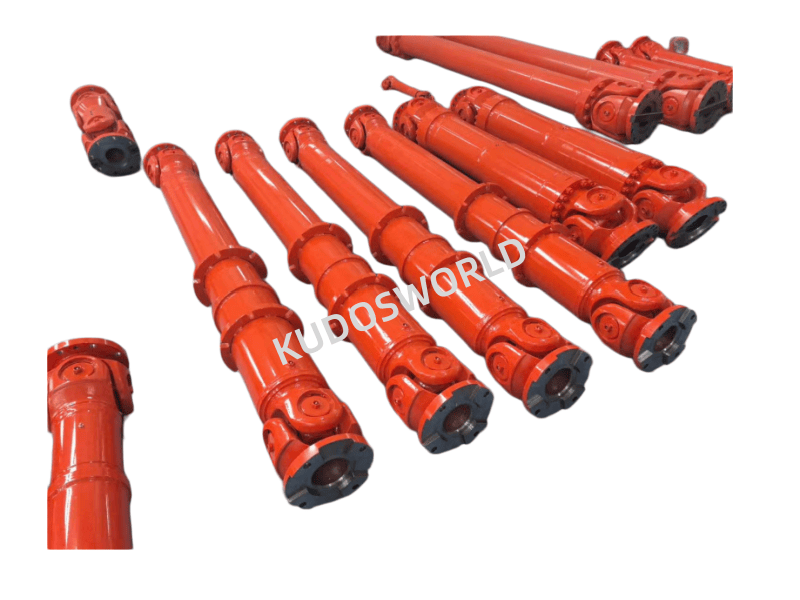
Core Application Scenarios for universal joint
1.Hot Rolling Lines:Used in the main drives of roughing, intermediate, and finishing mill stands. Due to uneven billet heating temperatures causing significant fluctuations in rolling force, universal joint must withstand peak torque shocks (reaching several times the rated torque) and accommodate high-angle transmission to maintain strip shape accuracy and surface quality.
2.Cold Rolling Lines:Applied in equipment such as high-speed reversing mills and skin-pass mills. These require high dynamic balancing precision (e.g., Grade G6.3 or higher) and low-vibration characteristics to ensure dimensional accuracy and smooth transmission for thin sheet and strip products.
3.Auxiliary Metallurgical Equipment: Widely used in ladle cars, coilers, straighteners, and conveyor systems. For instance, in ladle car drives, the shafts must accommodate dynamic loads and angular changes resulting from vehicle movement, ensuring uninterrupted power transmission in high-temperature environments.
Key Technical Features and Selection Requirements for universal joint
1.High Torque Capacity:Forged from high-quality alloy steels such as 35CrMo and 42CrMo and subjected to quenching, tempering, and surface heat treatment; the core cross-shaft component often utilizes 20CrMnTi to withstand impact loads several times the rated value.
2.Angular Compensation Capability: Allows for an angular misalignment of 15° to 45° between shafts (depending on the specific model), effectively addressing equipment layout constraints and shaft misalignment caused by thermal expansion.
3.Harsh Environment Adaptability:Designed for the high-temperature, dusty, and humid environments of steel mills, these shafts feature double-sided sealing structures to prevent grease leakage and contaminant ingress; some high-end models support long-term maintenance-free operation or predictive monitoring capabilities.
4.High-precision machining: The flange face of the yoke is machined using CNC 3D programming, with coaxiality error controlled within a very tight tolerance (e.g., ±0.02mm) and subjected to rigorous dynamic balancing tests to minimize vibration and noise.
For further inquiries regarding universal joint, please feel free to contact KUDOSWORLD—the coupling experts!