


Which companies specialize in manufacturing composite couplings?
2026-06-29 13:38As industrial equipment increasingly demands lightweight, corrosion-resistant, and maintenance-free components, composite couplings for cooling towers are emerging as a high-growth sector in the power transmission industry. Thanks to significant advantages such as low weight, fatigue resistance, and high critical speeds, these products are widely used in cooling tower fan drive systems across sectors like thermal power generation, petrochemicals, and metallurgy, attracting numerous domestic and international companies to enter the market.
In the international market, Rexnord—a century-old U.S. giant in power transmission—is undoubtedly a pioneer and benchmark in the field. As early as 1987, Rexnord introduced its advanced Addax composite coupling to the cooling tower industry. Featuring a patented modular flexible diaphragm and a carbon fiber drive shaft, the product weighs only 25% of a traditional steel shaft while offering exceptional corrosion and fatigue resistance; currently, over 50,000 of these composite couplings are in stable operation worldwide.
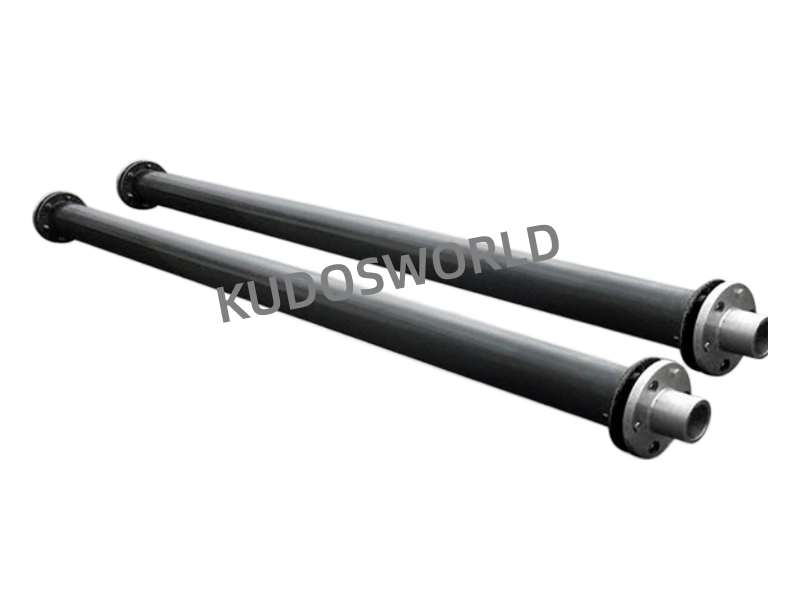
Meanwhile, Chinese enterprises are demonstrating strong momentum in technological innovation. Regarding core component R&D, SHENYANG KUDOSWORLD COMPANY has developed a carbon-fiber drive shaft for cooling tower fans featuring a split-type reinforced connection structure, significantly enhancing ease of assembly and disassembly as well as connection stability. In terms of complete unit manufacturing and engineering applications, the company has recently secured multiple contracts for composite material couplings and equipment retrofit projects with major enterprises. Leveraging its mature carbon-fiber molding technology, KUDOSWORLD offers the market cost-effective, customized composite coupling solutions; its products are currently exported to numerous countries, including Russia, Belarus, Turkey, Brazil, Chile, and Thailand.
Industry experts note that, driven by rising industrial environmental standards and the trend toward larger-scale equipment, composite couplings are gradually replacing traditional metal couplings due to their low life-cycle costs and operational stability. Looking ahead, the technological competition between domestic and international manufacturers regarding material formulation optimization and molding processes will further propel cooling tower drive systems toward greater efficiency and sustainability.
From a market perspective, the commercial adoption of composite-material couplings in large-scale industrial projects is entering a period of rapid growth. A case in point is Shandong Beinuo Cooling Equipment Co., Ltd., which has recently secured contracts for several major industrial projects—including the circulating water cooling tower upgrade and renovation for the methanol, polyvinyl alcohol, and BDO operations of Sinopec Great Wall Energy & Chemical (Ningxia) Co., Ltd., as well as projects for Xinjiang Tianneng Chemical Co., Ltd. and Sinochem Jilin Changshan Chemical Co., Ltd.—involving substantial contract values and procurement volumes. The implementation of these cooling tower retrofit projects, often costing millions, underscores the robust demand within downstream sectors—such as petrochemicals and chemicals—for high-performance composite transmission components.