



Cross head universal joint shaft Technical Analysis of Omnidirectional Angular Compensation and Heavy‑Duty Load Capacity
2026-03-11 15:01Cross head universal joint shaft, also known as a cross shaft rigid universal joint, is a key component for angular power transmission in industrial drive systems. It mainly consists of three critical parts: the cross shaft, universal joint yokes, and needle roller bearings.
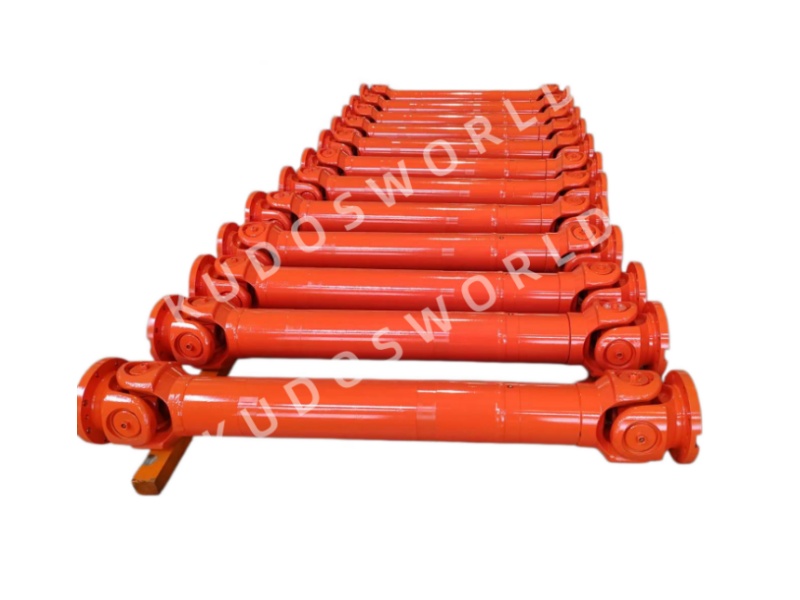
By mounting two shaft universal yokes onto the four journals of the cross, a spatial hinge connection is formed between the driving and driven shafts. As the driving shaft rotates, the driven shaft not only rotates synchronously but also swings freely around the center of the cross shaft in any direction, perfectly accommodating angular misalignment and axial displacement between the two transmission shafts.
To ensure long term stable operation, the cross shaft is generally equipped with a grease fitting and internal oil passages leading to the journals for continuous lubrication.
Core Structure and Precision Components
Although simple in appearance, the cross head universal joint shaft comprises multiple precisely matched components that collectively determine its performance and service life.
Cross Shaft(Core Torque Transmission Component)
The cross shaft is the core torque transmitting element, usually forged from 20CrMnTi carburizing alloy steel. After carburizing and quenching, its surface hardness reaches HRC 58–62, while the core retains excellent toughness to withstand high intensity shock and alternating loads.
Shaft Universal Yokes (Connection and Load Bearing)
Shaft universal yokes are divided into driving and driven ends, serving as the key interfaces connecting to the driving and driven shafts of equipment. They are available in two designs:
· One piece yoke: Manufactured via integrated forging, eliminating potential loosening risks from bolted connections. Torsional strength is increased by more than 40% compared with conventional structures, making it ideal for heavy duty applications such as rolling mills.
· Split yoke: Designed for easy disassembly and maintenance, allowing quick replacement of bearing assemblies. Commonly used in metallurgical, mining, and other equipment requiring frequent servicing.
Bearing Assembly and Lubrication System
The bearing assembly uses high precision needle roller bearings to minimize friction loss. The supporting lubrication system supplies grease regularly through the fitting on the cross shaft; grease flows directly to the friction pairs of journals and bearings, forming the foundation for low friction, long life operation.
Wide Application Fields
With outstanding angular compensation and high load carrying capacity, cross head universal joint shafts have become indispensable transmission parts in numerous industrial sectors.From ten thousand ton heavy metallurgical equipment to precision automated production lines, from marine propulsion to new energy wind turbine towers, diverse performance requirements have driven the development of various product series and customized solutions.
· Metallurgical industry: The largest application market, mainly used in the main drive systems of rolling mills to withstand heavy shock loads.
· Automotive industry: Widely applied in the drive shafts of rear wheel drive and four wheel drive vehicles for efficient power transmission.
· Construction machinery: Commonly used in key transmission parts of cranes, excavators, loaders, and other earth moving machinery.
· New energy equipment: Extremely high reliability requirements in wind and photovoltaic systems. For example, the yaw system of 1.5 MW wind turbines adopts one piece yoke universal couplings with a design torque capacity of 4500 kN·m and a service life of 20 years. Real time monitoring via an online vibration monitoring system (sampling frequency 1 kHz) improves fault prediction accuracy to 92%.
· Precision machinery: Miniature cross head universal joint shafts cover a torque range of 11.2–1120 N·m, suitable for precision machine tools, industrial robots, and other high precision equipment.
Scientific Selection and Market Outlook
Selection is critical to the reliability of the entire drive system. Factors including rated torque, maximum rotating speed, allowable angular misalignment, installation space, and actual working conditions must be comprehensively evaluated. Scientific calculation and application analysis are required to select the most suitable model. Improper selection may lead to premature failure and even equipment downtime, so a systematic selection method is essential.
According to industry reports, the market outlook for cross head universal joint shafts is promising.The market size in China is expected to reach 18 billion CNY by 2025 and exceed 26 billion CNY by 2030, with a CAGR of 7.5%. Strong demand from new energy vehicles, wind power, and high end equipment is driving significant growth. Among them, the drive shaft market for new energy commercial vehicles is growing at 38% annually, continuously boosting demand for high precision universal joints.
For more information and inquiries about universal joint. please contact Kudosworld.